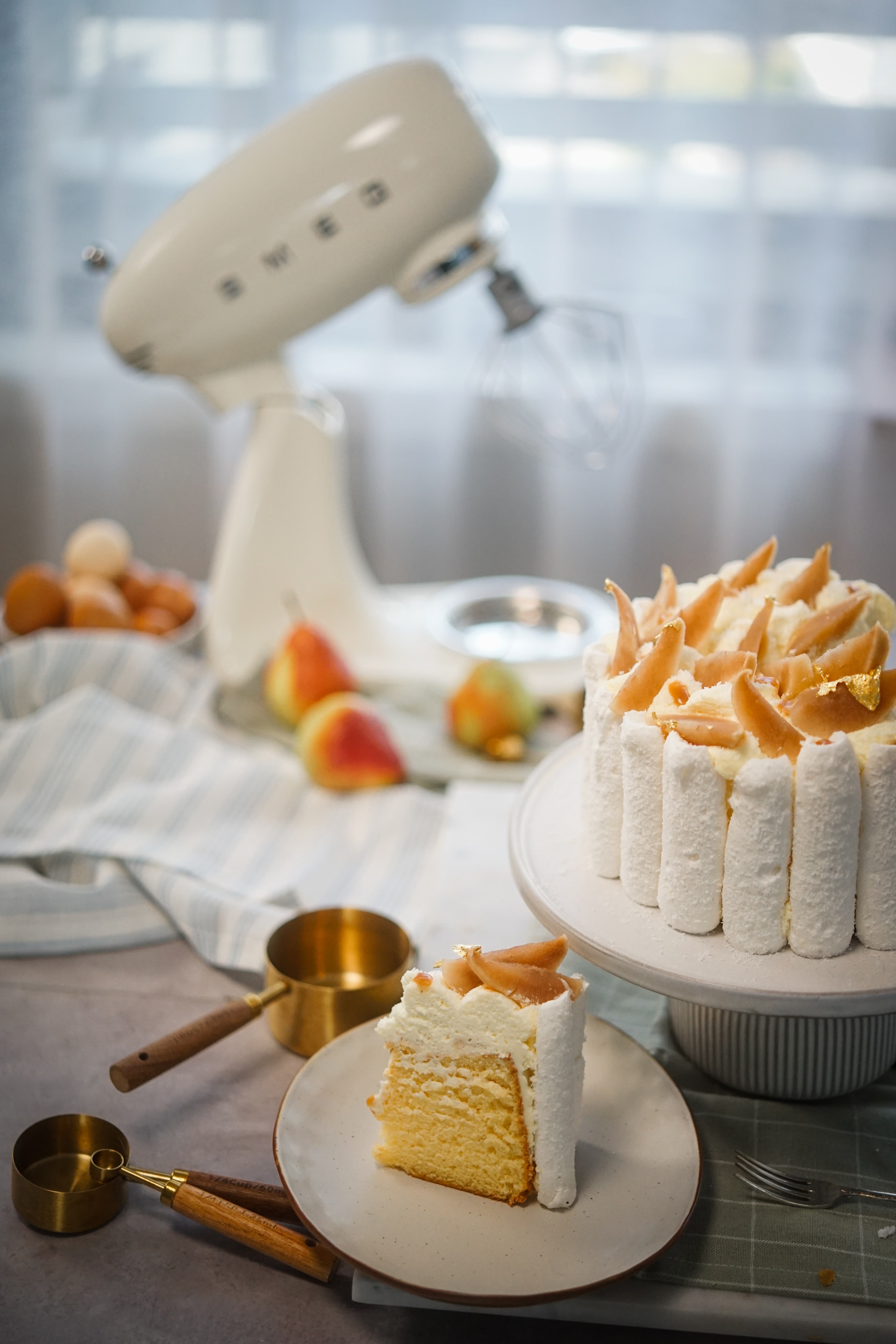
Pear, Coconut and Caramel Chiffon Cake
Soft chiffon, mascarpone Chantilly, salted caramel, coconut meringue, spiced pears. A lot going on, but it comes together.
Prep Time
2 hr
Cook Time
1 hr 30 min
Rest Time
30 min
Total Time
4 hr
Servings
10 slices
Difficulty
Challenging
This cake has been in my head for a while. Soft chiffon, mascarpone Chantilly, salted caramel, coconut meringue, spiced pears. A lot going on, but it comes together.
The chiffon is light and airy, the kind of cake that feels like it might float off the plate. The poached pears bring warmth from the spices, the caramel adds richness, and the coconut meringue bars give it texture and height. It looks impressive but the components are straightforward once you get into them.
I made this for a collaboration with Smeg using their stand mixer, and it reminded me why I love bakes like this. Multiple elements, each one simple on its own, building into something that feels considered.
Components
This cake has five components. I recommend making the poached pears and meringue bars a day ahead.
- Plain Chiffon Cake
- Spiced Poached Pears
- Salted Caramel Sauce
- Mascarpone Chantilly
- Coconut Meringue Bars
Plain Chiffon Cake
A light, oil-based sponge that stays moist for days. The key is properly whipped egg whites and gentle folding.
Tin size: 7" × 4.5" chiffon tin (ungreased)
Method
-
Preheat the oven to 180°C with no fan. Position the rack in the lower third of the oven.
-
Make the yolk mixture. In a large bowl, whisk the egg yolks with 75g of the sugar until pale and slightly thickened, about 2 minutes by hand or 1 minute with an electric whisk. Add the oil in a steady stream, whisking constantly. Add the milk and vanilla and whisk until combined.
-
Prepare the dry ingredients. Sift the plain flour, cornflour, baking powder, and salt together into a bowl. Sift again. This double sifting aerates the flour and helps create a lighter crumb.
-
Combine wet and dry. Add the sifted dry ingredients to the yolk mixture. Whisk until just smooth. Don't overwork it. Set aside.
-
Whip the egg whites. In a clean, dry bowl, whip the egg whites with the cream of tartar on medium speed until foamy. Gradually add the remaining 40g sugar, a tablespoon at a time. Continue whipping until you reach stiff peaks. The whites should be glossy and hold their shape when you lift the whisk.
-
Fold the whites into the batter. Add one third of the whipped whites to the yolk mixture and fold gently to lighten it. Add the remaining whites in two additions, folding carefully each time. Use a large spatula and turn the bowl as you fold. You want to keep as much air as possible.
-
Bake. Pour the batter into an ungreased chiffon tin. Run a chopstick or skewer through the batter in a few circles to release any large air bubbles. Reduce the oven temperature to 160°C and bake for 45–50 minutes. The cake is ready when it springs back when touched and cracks have formed on the surface.
-
Cool upside down. Immediately invert the tin onto its feet or over a bottle neck. Cooling upside down prevents the cake from collapsing. Let it cool completely, at least 1–2 hours, before unmoulding.
Spiced Poached Pears
Gently poached in a fragrant syrup with cinnamon, cardamom, and cloves. These can be made a day ahead and stored in the poaching liquid.
Method
-
Peel the pears. Use a vegetable peeler and work from top to bottom in long strokes. Keep the stems intact for presentation.
-
Make the poaching syrup. Combine the water, sugar, cinnamon sticks, lemon zest, cardamom pods, cloves, and vanilla in a large saucepan. Stir over medium heat until the sugar dissolves, then bring to a gentle simmer.
-
Poach the pears. Carefully lower the pears into the syrup. They should be mostly submerged. If needed, cut a circle of baking paper to sit on top and keep them under the liquid. Poach at a gentle simmer for 12–15 minutes for Corella pears (10–12 minutes for Packham). The pears are ready when a paring knife slides in with slight resistance. They should be tender but still holding their shape.
-
Cool in the liquid. Turn off the heat and let the pears cool completely in the syrup. This allows them to absorb more flavour and keeps them moist. You can refrigerate them in the syrup for up to 24 hours.
-
Prepare for decorating. Drain the pears and pat completely dry with paper towels. Slice just before assembling the cake.
Pear Tips
- Temperature matters more than time. Keep the syrup at a gentle simmer, not a rolling boil. You want the liquid to tremble, not bubble aggressively. Too much heat breaks down the flesh and dulls the flavour.
- Watch for visual cues. The pears should look slightly translucent at the edges and deepen in colour evenly.
- If the knife slides in with no resistance, they've gone too far. Still usable, just handle gently.
- The sugar to water ratio here is intentionally high for decorative poached pears with a firmer texture. For a plated poached pear dessert where you want softer fruit, use a 1:1 syrup ratio instead.
Salted Caramel Sauce
Rich, buttery, and just salty enough to cut through the sweetness. Make this while the cake is cooling.
Method
-
Make the caramel base. Combine the sugar and water in a medium saucepan. Stir gently to wet all the sugar, then stop stirring. Place over medium-high heat and cook without stirring until the mixture turns a deep amber colour. Swirl the pan occasionally for even colouring. This takes about 8–10 minutes.
-
Add the cream. Remove the pan from the heat. Carefully pour in the warm cream. The mixture will bubble up aggressively, so stand back. Whisk gently until smooth.
-
Finish with butter and salt. Add the butter and whisk until melted and incorporated. Add the salt, starting with ½ teaspoon. Taste and add more if needed.
-
Cool before using. Let the caramel cool to a pourable but thick consistency. It will continue to thicken as it cools. If it gets too thick, gently rewarm it.
Caramel Tips
- Warm the cream before adding. Cold cream causes the caramel to seize and splatter.
- Don't stir once the sugar is dissolved. Stirring causes crystallisation.
- Deep amber, not light golden. Darker caramel has more complexity and balances the sweetness.
Mascarpone Chantilly
A richer, more stable version of whipped cream. The mascarpone adds body and a subtle tang.
Method
-
Whip the mascarpone. Place the mascarpone and sugar in the bowl of a stand mixer fitted with the whisk attachment. Whip on medium speed until light and fluffy, about 2 minutes. Scrape down the sides of the bowl.
-
Add the cream. Reduce the speed to medium-low. Pour in the cream in a slow, steady stream. Once all the cream is added, increase the speed to medium-high and whip until you reach medium peaks. The Chantilly should hold its shape but still look soft and billowy.
Chantilly Tips
- Don't overwhip. Mascarpone can split if taken too far. Stop as soon as you have medium peaks.
- Everything should be cold. Cold cream and cold mascarpone whip better.
Coconut Meringue Bars
Crisp, light meringue bars studded with coconut. These add height and texture to the finished cake.
Method
-
Whip the meringue. Combine the egg whites, icing sugar, and xanthan gum in the bowl of a stand mixer. Whip on medium-high speed until thick, glossy, and fluffy, about 5–7 minutes.
-
Fold in the coconut. Add the 55g of desiccated coconut (A) and fold in gently with a large spatula until evenly distributed.
-
Pipe into logs. Transfer the meringue to a piping bag fitted with a 2cm round tip. Pipe long, straight lines onto a silicone mat-lined baking tray. Keep them as even as possible.
-
Top with more coconut. Sprinkle the remaining 40g of desiccated coconut (B) over the piped meringue for extra texture.
-
Dry in the oven. Bake at 80°C until completely dry to the touch. This takes anywhere from 45 to 90 minutes depending on your oven and humidity. The meringues should lift off the mat easily and feel light.
-
Trim and cut. Once cooled, use a sharp knife to trim the edges and cut into 5-inch bars that will fit around the height of your cake.
Meringue Tips
- Low and slow. These are dried more than baked. Keep the temperature at 80°C to avoid browning.
- Make these a day ahead. They keep well in an airtight container at room temperature.
- The xanthan gum helps stabilise the meringue and gives it a slightly chewy interior.
Assembly
Bring everything together. Work efficiently once the Chantilly is on, as it softens at room temperature.
Method
-
Unmould the chiffon cake. Run a thin spatula or knife around the edges and centre tube. Invert onto a serving plate or cake board.
-
Cover with Chantilly. Using an offset spatula, spread a generous layer of mascarpone Chantilly over the top and sides of the cake. Smooth it out, but don't worry about perfection. A slightly rustic finish works well here.
-
Attach the meringue bars. Gently press the coconut meringue bars around the sides of the cake, standing upright. They should stick to the Chantilly. Space them evenly.
-
Drizzle with caramel. Spoon or drizzle the salted caramel generously over the top of the cake, letting it pool and drip naturally.
-
Pipe Chantilly domes. Fit a piping bag with an 18mm round tip. Pipe domes of varying sizes on top of the cake, clustering them for a natural look.
-
Add coconut. Sprinkle a little desiccated coconut over the Chantilly domes.
-
Arrange the pears. Slice the poached pears and arrange them on top of the cake, nestling them among the Chantilly domes.
-
Finish with caramel dots. Pipe or spoon small dots of caramel randomly over the top for a final touch.
-
Serve or refrigerate. The cake can be served immediately or refrigerated for up to 4 hours. Bring to room temperature for 20 minutes before serving for the best texture.
Notes
- Make ahead: The poached pears and meringue bars can be made a day ahead. The caramel can be made a few hours ahead and gently rewarmed. The chiffon cake can be baked the morning of and left inverted until ready to assemble.
- Storage: Once assembled, the cake is best eaten within 6–8 hours. The meringue bars will soften over time.
- Substitutions: Packham pears work if Corella are unavailable. Adjust poaching time as they soften faster.
Tips & Notes
- 1Don't grease the tin. Chiffon cakes need to cling to the sides as they rise.
- 2Room temperature eggs whip better than cold ones.
- 3If the cake sinks after inverting, it's likely underbaked. Next time, leave it in a few minutes longer.
- 4Temperature matters more than time. Keep the syrup at a gentle simmer, not a rolling boil.
- 5Warm the cream before adding to caramel. Cold cream causes the caramel to seize and splatter.
- 6Don't overwhip the Chantilly. Mascarpone can split if taken too far.
- 7Make the meringue bars a day ahead. They keep well in an airtight container at room temperature.
Tags
Published 18 January 2025